A practical guide to help Navigate the budgeting process
Preparing for your Disney Program is exciting and a little overwhelming. You are thinking about roles, roommates, packing lists, and park days, but one of
the most important pieces of preparation is often the most ignored: building a realistic budget. Your program will be full of memories and opportunities,
but it also comes with weekly financial responsibilities. Rent, food, transportation, and taxes do not take a week off just because you are having fun.
Many future participants are not sure where to begin, especially if they do not yet know their role, exact schedule, or how many hours they will be working. It is easy to fall back on the idea that “it will all work out,” but Navigator recommends taking a little time before arrival to understand how money flows into and out of your paycheck. Once you understand that pattern, your budget becomes much easier to plan and manage.

Starting Point: Build Your Budget Based on Your Minimum Income
The best place to begin is not with the most optimistic version of your income, but with the minimum you can count on. As a Disney College Program participant, Disney guarantees that you will be scheduled for at least 30 hours of work per week. You may work more — many participants do — but there is no promise beyond those 30 hours. For budgeting purposes, it is safest to assume only those guaranteed hours and treat anything above that as extra.
For 2026, the base pay rate for College Program roles is $18 per hour. Some specific roles pay more, but unless you already know your role and pay rate, you should build your first draft budget using that base rate. If you multiply the guaranteed 30 hours by $18 per hour, you get a weekly gross income of $540 before taxes and rent. That $540 is your starting number. Your actual take-home pay will be lower once taxes and rent are deducted, but having this anchor number makes the rest of the budgeting process much easier.
How Taxes Affect Your Paycheck
Before we talk about rent and spending money, it helps to understand how taxes affect each paycheck. The good news is that Disney handles the actual withholding for you; you do not have to send money in yourself each week. However, you do need to understand roughly how much will be taken out so you can plan your budget around what you will actually see in your bank account.
Federal Income Tax
During onboarding, you will complete an IRS form called the W-4. This form tells Disney how much federal income tax to withhold from your paycheck. You may have completed a W-4 at a previous job, but even if you have, you will fill out a new one specifically for your Disney employment.If you want to take a look at the W4 form and complete instrucitons for it: Click here
Navigator recommends a simple rule of thumb for budgeting: plan for about 10% of your gross pay to go toward federal income tax. If you earn $540 in a typical week, ten percent would be about $54 withheld for federal tax. Again, Navigator is not a Tax Expert. Using 10% for your budget is just a recommendation. Your situation may be different.
If a participant extends their program they could be there for a year — earning between $27,000 and $38,000. (Tip: If you extend your program you should take another look at your Federal Withholding and adjust it if needed) after the standard deduction. That means budgeting with 10% gives you a built-in cushion. Many CPs will receive a federal tax refund at the end of the year. This refund can be especially helpful if your home state has income tax and you owe state taxes on the money you earned during your program.
Social Security and Medicare Taxes
In addition to federal income tax, your paycheck also includes automatic deductions for Social Security and Medicare. These are sometimes called “FICA taxes” and total 7.65% of your gross pay.
Using the $540 weekly example, 7.65% comes to roughly $41 per week. This amount is automatically withheld regardless of what you write on your W-4.
State Income Tax and Your Home State
Florida does not have a state income tax, but your home state may. Many states require residents to pay state income tax on all income earned, even if it was earned in another state. Disney will not withhold tax for your home state, so it becomes your responsibility to research your state’s rules and prepare accordingly.
This is another reason the 10% federal withholding rule is useful — when you receive a refund, that money can help cover taxes owed to your home state.
How Rent Fits Into the Picture
Once taxes are taken out, the next major piece of your financial puzzle is rent. Most College Program participants live at Flamingo Crossings Village, which is owned and operated by American Campus Communities (ACC). Your rent is not something you pay manually. Instead, Disney automatically deducts your rent from your paycheck each week and sends it directly to ACC.
Each week follows the same pattern: you work your scheduled hours, Disney calculates your gross pay, federal and payroll taxes are withheld, your Flamingo rent is deducted, and the remaining amount is direct deposited into your bank account. That final number — what actually lands in your bank — is your real weekly spending money.
When Your Rent Actually Starts
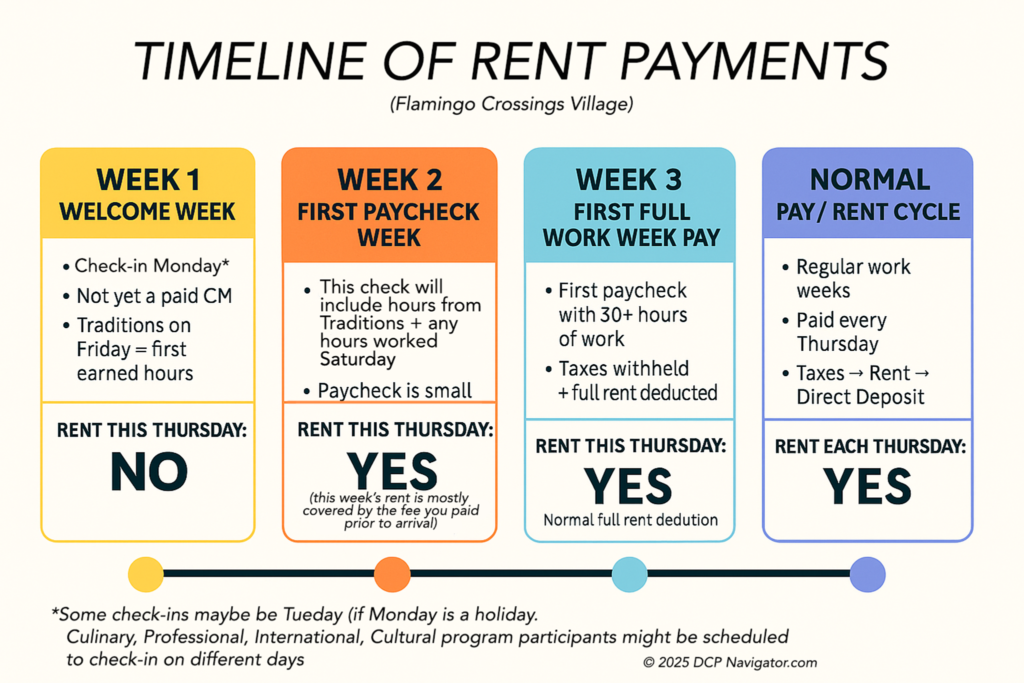
Rent timing can be confusing, especially during the first few weeks. Most participants arrive on a Monday (or Tuesday if Monday is a holiday). This first week is known as Welcome Week. You are not yet a paid Cast Member until you attend Traditions, usually on Friday.
Your first Thursday at Flamingo falls during Welcome Week, and no rent is deducted because you have not yet earned any pay. The following Thursday, you will receive your first paycheck, which is usually small and includes only the hours from Traditions and any weekend training. Rent is associated with this week, but in most cases, the cost is offset by the program fees you paid before arrival. For more info on the DCP fees, head to the Disney Support Site: Click here
By your third Thursday, you typically receive your first “normal” paycheck with at least 30 hours of work. This is the first time full rent is deducted from a full paycheck, and from then on, the weekly cycle repeats.
NO WORK = NO PAY
This is a harsh reality that catches some CPs by surprise. If you don’t work the hours you don’t get paid for the hours. CPs don’t get paid sick days or paid time off. You will be guaranteed to be scheduled for at least 30 hours but if you;
-
-
- Request a day off and it is approved.
- Call Out (sick day or personal day)
- Have the chance to leave work early (Called an ER or Early Release) and take it.
-
You don’t get paid for those hours.
RENT IS STILL DEDUCTED FROM YOUR CHECK
This is important for you to understand. Rent will be deducted even if there is not enough to cover the full amount. Let’s say your rent is $227/week and you only worked two shifts that week. (one shift was 8 hours, and the other 6 hours = 14 hours total). Taxes will be deducted from your check first, and then rent so with only 14 hours of work, there probably won’t be enough to cover all the rent. That means that your paycheck will be zero dollars, and you’ll get an email telling you that you still owe the remainder of the rent and how to pay it.